Disney by Rees Quinn
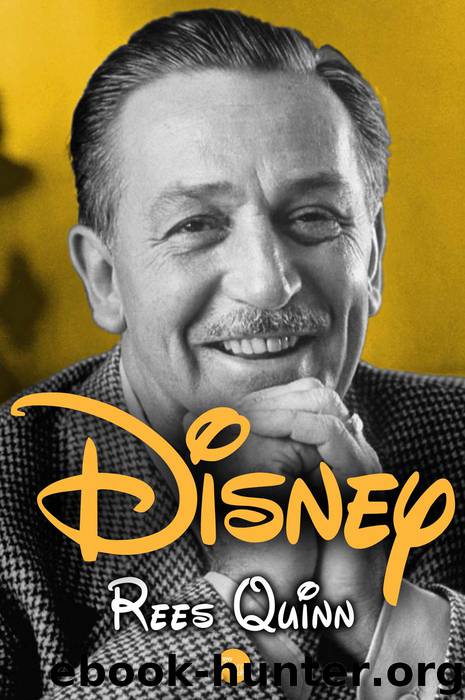
Author:Rees Quinn
Language: eng
Format: mobi, epub
Tags: Biography/Entertainment and Performing Arts
ISBN: 9781612307947
Publisher: New Word City, Inc.
Published: 2014-06-24T23:00:00+00:00
Disney’s employees were aware of the company’s financial problems. In 1940, the Disneys had sold stock in the company and set aside 20 percent of the shares for employee compensation. The Disney Brother Studio was one of the first American companies to share ownership with its workers this way. But as share prices fell, the studio bought back much its stock. Shares that started at $25 eventually plummeted to $3.
By February 1941, the studio’s main creditor, the Bank of America, insisted on cost-cutting measures. To circumvent this, Disney devised a way of giving his best animators incremental raises in hopes the bank would not notice. Although the company had posted a small profit in 1941 and had retired earlier debts and property mortgages with the stock sale, losses from Pinocchio and Fantasia were mounting. Disney decided to quickly produce a lower-budget animated feature: Dumbo.
Back in October 1940, the Screen Cartoonists Guild (SCG) launched an effort to unionize the Disney studio. By early December, the SCG had collected cards from a majority of the studio’s employees approving the union.
Disney understood that his employees were concerned about the prospect of layoffs, given the company’s financial position, but the union decision wasn’t strictly about money. Disney’s more talented and senior animators were frustrated by slaving away anonymously for an authoritarian taskmaster who took all the credit. Other than Mickey Mouse, the Disney name was the only one that ever figured prominently in the credits of a Disney release.
Disney was livid when he learned of the potential unionization. He called in senior animator Art Babbitt, one of his most valued and trusted employees and insisted Babbitt help stop the union action. Disney threatened to close down the studio before giving in to a union. Babbitt said he could not help.
Disney thought if his whole staff took a vote, they would reject the union. But the SCG declined a vote and reiterated that if the company did not sign with the union, studio employees would strike. In February 1941, Disney called a meeting with his employees. He reminded them that when other studios had cut salaries during the Depression he had continued to pay handsome bonuses even when the company was strapped for cash, but the speech backfired. In attempting to address the staff’s concerns, Disney only reminded his employees of their list of grievances. Disney’s plea as their heroic leader came across as a sob story.
When Babbitt became a vocal leader of the SCG, Disney was enraged. He told Babbitt that if he kept organizing the studio’s employees he would be “thrown out the front gate.”
But Babbitt was stubborn and fearless and popular with the other employees. That spring, just as Disney was ready to fire him, Babbitt married young Marjorie Belcher, the model for Snow White. Disney held his fire. But by March, Disney had started referring to him as a punk.
In late May 1941, Disney fired twenty animators who had signed with SCG. A week later, he fired Babbitt. The strike began the next day.
Download
This site does not store any files on its server. We only index and link to content provided by other sites. Please contact the content providers to delete copyright contents if any and email us, we'll remove relevant links or contents immediately.
| Africa | Asia |
| Canadian | Europe |
| Holocaust | Latin America |
| Middle East | United States |
Fanny Burney by Claire Harman(26607)
Empire of the Sikhs by Patwant Singh(23090)
Out of India by Michael Foss(16861)
Leonardo da Vinci by Walter Isaacson(13341)
Small Great Things by Jodi Picoult(7155)
The Six Wives Of Henry VIII (WOMEN IN HISTORY) by Fraser Antonia(5519)
The Wind in My Hair by Masih Alinejad(5102)
A Higher Loyalty: Truth, Lies, and Leadership by James Comey(4966)
The Crown by Robert Lacey(4820)
The Lonely City by Olivia Laing(4807)
Millionaire: The Philanderer, Gambler, and Duelist Who Invented Modern Finance by Janet Gleeson(4482)
The Iron Duke by The Iron Duke(4367)
Papillon (English) by Henri Charrière(4278)
Sticky Fingers by Joe Hagan(4207)
Joan of Arc by Mary Gordon(4117)
Alive: The Story of the Andes Survivors by Piers Paul Read(4037)
Stalin by Stephen Kotkin(3973)
Aleister Crowley: The Biography by Tobias Churton(3646)
Ants Among Elephants by Sujatha Gidla(3470)
